How American media lost, transformed, and might recover its public purpose.
The press had not yet become a national mass medium, but it had already become indispensable to public life. A town knew its printer. A paper had a party, and the party was on the page. What changed was not the disappearance of partisanship. It was the loss of local accountability, and the rise of a national voice that fewer and fewer people could answer.
Commercial success gave the public more access, and weakened the old restraints on a publisher. Television did not merely reflect a consensus. It staged one. The internet did not simply decentralize the media. It handed out the press, then built a new gate no reader can see. The pictures on this walk are of the events, or the caption says they are not. A date is a fact. A sentence about what it meant is a reading. A fight still open is disputed. Anything after 2026 has not happened.
Share sends the film into a text when the phone allows it. Download it to post on X or Facebook.
Who controls distribution?
A printer. Then a network. Then a brand. Then a machine.
Who defines public truth?
A named argument, a shared wire, or a feed that never shows its work.
Who is accountable?
An editor in a town, or a company that has no town.
Gallup · the same question
Who still believes the report.
1970s70%
201845%
202431%
202528%
202633%
“Great deal” or “fair amount” of confidence that newspapers, television, and radio report fully, accurately, and fairly. September 2026: Republicans 22 percent, Democrats 50, independents 31. The 1970s bar is Gallup’s summary, about seven in ten, not one year. Gallup, September 2026.
A partisan press · Fact · Foundational
1776
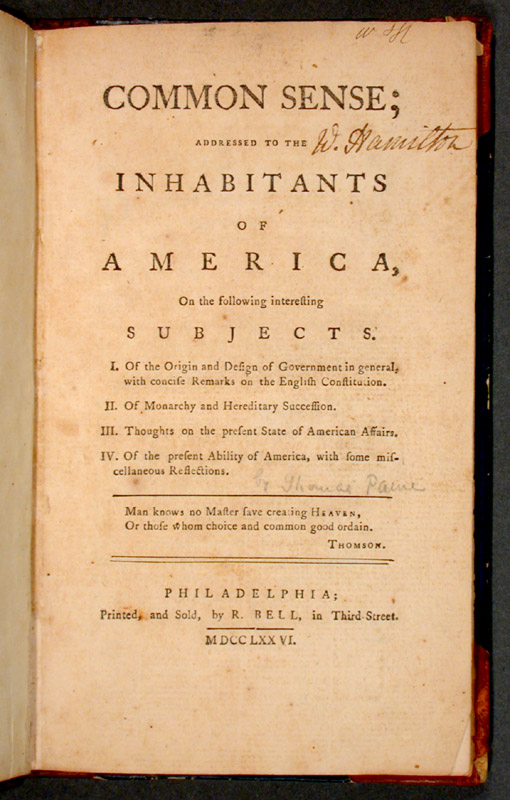
Common Sense
Thomas Paine’s pamphlet argues, in plain speech, that the colonies should leave the Crown.
January 10, 1776
The thing itself: the title page of Common Sense, 1776. Public domain.
1 of 48
It is not a newspaper, and it is not neutral. It is a pamphlet, sold cheap, read aloud, and passed on. The press of the Revolution is sermons, handbills, and papers with a side. There is no national evening. A town knows its printer. What the pamphlet proves is that a public can be moved by a page before there is a mass audience, and that the page is already a political act.
Why it matters
Print is a tool of mobilization, not yet an industry of attention.
The thread
The later fight over who may publish begins here, with a page a government did not license.
The other side
Paine’s own later politics, and the violence of the decade, are not a warrant to treat every revolutionary sheet as honest.
Library of Congress holdings of Thomas Paine, Common Sense (1776).
The whole walk, in order
The future of the public square
This history is not a march from censorship to freedom, or from virtue to decay. It is a recurring argument over who moves a fact, which communities count as a public, and whether a private system that lives on attention owes anything to the town it distracts. The founding paper was partisan and narrow. The mid-century network could leave people out and still call the hour common. The feed widened the door and built a new lock behind it.
The repair is not a return to three networks. It is a reporter in the room where the board votes, a correction printed where the error ran, and a house that can tell a report from a side. For a Christian people that is not only a conclusion. It is a discipline: tell the truth, and do not claim a monopoly on the truth you are still obliged to seek. The founding paper and the feed are both imperfect instruments. Each one asks the same question. Does this medium enlarge responsible participation in public life, or does it make a people easier to move?
That section is a reading. The final chapter is not in the record.
Words we are using
Gatekeeping
A person or a rule that decides what reaches an audience.
A reading
What we think the fact means. Marked, so it is not mistaken for the fact.
Fairness Doctrine
A 1949 FCC duty on licensed broadcasters: cover public controversy, and offer contrasting views. Not equal time. Not a rule for newspapers, cable, or the web.
The feed
An order of items chosen for a person, usually by what is likely to hold them.
Corrections
None yet. If a date or a picture is wrong, the correction will be written here with the day and the reason.
48 stops. Where there is no picture, we did not borrow one. A longer shelf is owed. We will not invent the dates, or the photographs, to fill it.
For this house
Keep going
The next title is the one nearest what this house keeps, then the measure where it is thin. Nothing here is a crowd. It does not leave this device.